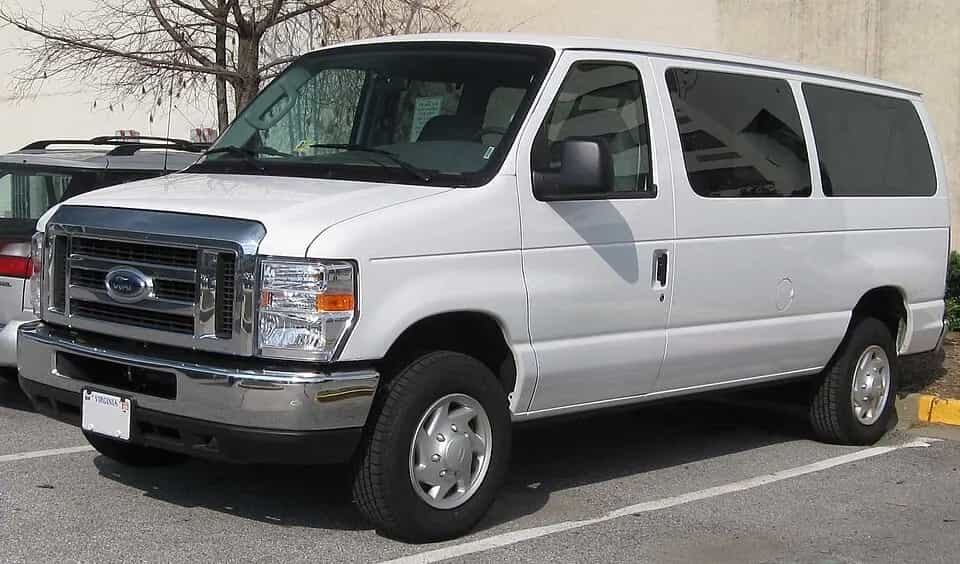
Ford E-Series Econoline Van

Importing a used Ford E-Series Econoline Van from the USA

Few vehicles are as thoroughly American as the Ford E-Series, the full-size van most people still call by its original name, Econoline. For more than five decades it was the default workhorse of US plumbers, church groups, camper builders and airport shuttles, and that ubiquity is exactly why it makes sense as an import today. The used market in the States is deep, body-on-frame simplicity keeps repair costs low, and the V8 and V10 drivetrains are known quantities. If you want a body shell for a camper conversion, a genuine American shuttle, or a rugged cargo hauler that no European van quite replicates, importing a used Ford E-Series Econoline Van from the USA is a rational move. As an independent broker, USCar Trader sources these vans for German and EU buyers without acting as a dealer or holding stock.

Ford e-series-econoline-van – used car imported from the USA
Photo: IFCAR · Public domain · Wikimedia Commons

Model history and generations

The Econoline launched in 1961 as a compact, cab-over van, but the vehicle relevant to importers is the fourth generation introduced for 1992 and built with steady updates until 2014. This is the familiar big van on a proper ladder frame, sold as E-150, E-250, E-350 and, in heavier chassis form, E-450. Ford rebranded the line as "E-Series" in the early 2000s while everyone kept saying Econoline. Full-size passenger and cargo van production ended in 2014 when the Transit took over, but the stripped chassis and cutaway (E-350/E-450) continued for RV and box-truck use well beyond that. A 2008 facelift brought a revised dash and updated engines, so build year matters when you shop.

Engines and drivetrain

Nearly every imported example is rear-wheel drive with a longitudinal V8 or V10. The mainstream units are the 4.6-liter and 5.4-liter Triton V8s, with the 6.8-liter Triton V10 reserved for E-350/E-450 heavy haulers and motorhome chassis. Earlier fourth-gen vans offered the legendary 7.3-liter Power Stroke turbodiesel (through 2003), later replaced briefly by the 6.0-liter Power Stroke. Transmissions are stout Ford automatics: the 4R70W and 4R100 on older vans, and the TorqShift 5R110W five-speed on later 5.4 and 6.8 models. These are simple, torque-rich drivetrains built for load, not for economy.

Which trim makes sense

The range splits into cargo vans (empty load bay), the Club Wagon passenger version with up to 15 seats, and cutaway/chassis-cab variants that underpin ambulances, shuttles and Class C motorhomes. You will also find countless aftermarket conversions: high-top campers, wheelchair-accessible builds and mobile workshops. Regular and extended ("Super") wheelbase lengths were offered, the latter adding useful cargo volume behind the rear axle. Because so many left the factory as bare chassis, condition and upfit quality vary enormously from van to van.

Supply on the US market

Supply is excellent. Fleet-operated Econolines turn over constantly, and dry-state examples from the Southwest routinely survive with clean underbodies. Typical import candidates are 2005–2014 vans; earlier 7.3 diesels command a loyal following and often show high but well-documented mileage. Six-figure odometers are normal on these commercial vehicles, so service history and rust status matter far more than the number on the dash. Look closely at conversion vans, which may have sat unused for years.

Who benefits from importing

An E-Series suits camper and overland builders who want a durable, easily serviced platform, businesses needing an authentically American shuttle or event vehicle, and enthusiasts drawn to the classic full-size van format that Europe never sold. It is not the choice for anyone chasing fuel efficiency or tight-street maneuverability. If your priority is a robust, repairable body-on-frame van with cheap US parts availability, this is the segment benchmark.

Technical data

AttributeTypical value (fourth-gen E-Series)
Body stylesCargo van, Club Wagon passenger, cutaway/chassis cab
LayoutFront engine, rear-wheel drive
Trims/classesE-150, E-250, E-350, E-450
Petrol engines4.6 L Triton V8, 5.4 L Triton V8, 6.8 L Triton V10
Diesel engines7.3 L Power Stroke V8, later 6.0 L Power Stroke V8
Power (typical)~225–305 hp petrol; ~235 hp diesel
Transmission4R70W / 4R100 4-speed; 5R110W TorqShift 5-speed auto
Seating (Club Wagon)Up to 15
WheelbaseRegular and extended (Super) lengths
Fuel tankApprox. 132–190 liters depending on config
GVWR classE-150 light-duty to E-450 heavy-duty
Production (van)Fourth generation 1992–2014
OriginUS-assembled (verify VIN/plant)
Fuel typePetrol or diesel

Known weak points and maintenance

The E-Series is fundamentally durable, but the two-valve Triton engines have well-known weak points. The 5.4 and 6.8 are notorious for spark-plug blow-out, where the plug threads strip out of the aluminum head; a thread repair insert is the standard fix. Exhaust manifold studs corrode and snap, causing a ticking exhaust leak. Watch for rust on rear wheel arches, rocker panels and the frame on rust-belt vans, plus tired ball joints and front-end bushings on high-mileage examples. The 7.3 Power Stroke is famously long-lived but check for injector and turbo wear. Overall, Econoline common problems are cheap and well documented, which is a big part of the van's appeal.

US and EU spec compared

The Econoline was never officially sold in Europe, so every example is a genuine US-spec vehicle. Expect amber-free rear indicators, a missing rear fog lamp, mph-primary instruments and US federal lighting. Fifteen-passenger Club Wagons and cutaway chassis raise weight-class and driving-licence questions in Germany, so confirm the permissible gross weight before you buy. Emissions equipment is US-federal, which matters at the individual approval stage.

The import process in detail

The process runs: select the van and agree terms through USCar Trader as broker; verify the VIN and the build plant to establish origin; place funds in escrow for security; arrange ocean freight (usually RoRo or container from a US East or Gulf port); handle EU customs clearance on arrival; complete TÜV and individual approval (Einzelabnahme); then register the van in Germany. Large cutaway and 15-seat vans may need extra documentation.

What customs clearance really costs

In short: the 0% duty rate applies only with documented US origin (VIN/plant) – German import VAT of 19% is always due.

Two charges are separate and must not be confused. Import duty depends on the van's actual country of origin: with provable US origin (VIN/plant, direct transport), the 0% EU rate under Regulations (EU) 2026/1455 and 2026/1461 can apply for imports between 1 July 2026 and 31 December 2029; without that proof the standard commercial-vehicle rate applies. On top of duty, the 19% German import VAT (Einfuhrumsatzsteuer) always applies to the customs value. We never quote this as duty-free or guaranteed, and we add no margin.

TÜV, modifications and registration

Typical changes for approval include converting the rear lighting to include a rear fog lamp and EU-legal indicators, verifying headlight beam pattern, and confirming the odometer reads correctly (a km conversion or documentation is expected). Passenger conversions and campers need their seating, gas and electrical installations documented. Budget realistic time for a heavy or converted van at the TÜV.

Check before you buy

  • Decode the VIN and confirm engine, plant and build year.
  • Pull a Carfax or AutoCheck history for accidents, title brands and odometer records.
  • Inspect frame, wheel arches and rockers for rust, especially on non-desert vans.
  • Verify title status is clean (not salvage/rebuilt) unless you accept the risk.
  • Check spark-plug and manifold repair history on 5.4/6.8 engines.
  • On conversions, review the upfit quality and any gas/electrical certification.
  • Confirm gross weight rating against your intended use and licence.

Common questions

Can I import a used Ford Econoline into Germany?

Yes. As a used US vehicle it is eligible for import and individual approval; the main hurdles are lighting, weight class and paperwork, all of which are routine.

Which engine should I look for?

The 5.4 Triton V8 is the most common and best-supported petrol unit; the 7.3 Power Stroke diesel is the enthusiast pick for durability.

Is the 15-passenger Club Wagon a problem to register?

It can raise weight-class and licence questions in Germany, so confirm the permissible gross mass and your driving entitlement before purchase.

Do I pay customs duty on an Econoline?

Duty depends on provable origin. US-built vans with VIN/plant proof may qualify for the 0% rate in the current window; otherwise the standard rate applies. The 19% import VAT is always due.

How is it shipped from the USA?

Usually by RoRo or container from a US port. USCar Trader coordinates escrow, freight and clearance as your broker.

Are parts available in Europe?

Wear and service parts are widely available and inexpensive thanks to the van's huge US production run; some trim items may need US ordering.

What mileage is acceptable?

These are commercial vehicles, so high mileage with good documentation is normal and often preferable to a neglected low-mileage van.

Ready to start? Browse the wider Ford in the Carhub, compare related workhorses like the Ford Transit Van, the Ford E-Series Econoline Wagon and the Ford Excursion, or view current E-Series Econoline Van listings.